
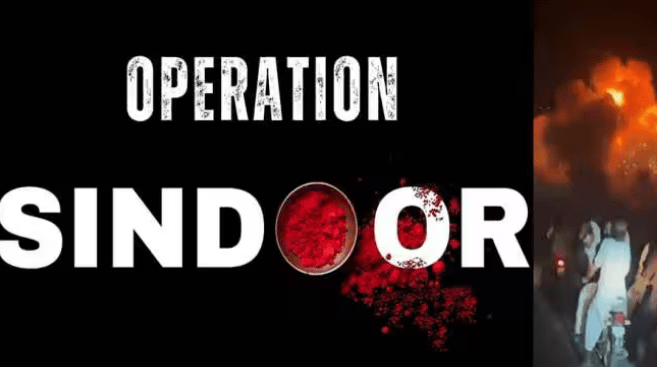
Operation Sindoor LIVE updates: Strikes were launched to bring justice to Pahalgam victims, says Centre
Operation Sindoor LIVE updates: Strikes were launched to bring justice to Pahalgam victims, says Centre
In a historic joint operation, the Indian Army, Navy, and Air Force conducted precision strikes at 1:44 am last night on terror infrastructure located in Pakistan and Pakistan-Occupied Kashmir. The action was taken in response to the Pahalgam attack on April 22, which claimed the lives of 26 civilians.
India targeted nine locations across Pakistan and PoK that were being used to plan and execute terrorist activities. The operation, codenamed ‘Operation Sindoor’, was named in tribute to the women who lost their husbands in the Pahalgam attack.
Operation Sindoor: Full Coverage
How India tracked terror hideouts in Pakistan? The agency behind operation’s success
India has taken decisive action against terrorists hiding in Pakistan, destroying nine terror hideouts in Pakistan and Pakistan-occupied Kashmir (PoK) and eliminating approximately 30 terrorists. In the early hours of Wednesday, the Indian armed forces conducted missile strikes on nine terror targets, including the Jaish-e-Mohammed stronghold in Bahawalpur and Lashkar-e-Taiba’s base in Muridke. Let’s learn about how India managed to obtain such precise intelligence on the terrorist locations.
The National Technical Research Organisation (NTRO) tracked the terrorists hiding in Pakistan and Pakistan-occupied Kashmir (PoK), providing India with confirmed intelligence on their locations. It is believed that several top terrorist commanders may have been eliminated in the Indian strikes.
What is NTRO?
NTRO is India’s technical intelligence agency, established in 2004. It operates under the National Security Advisor (NSA) and the Prime Minister’s Office (PMO). Its primary role is to gather advanced technical intelligence, playing a crucial part in safeguarding India’s national security, particularly in addressing terrorism, cyber threats, and cross-border threats.
🎓 Explore Jobs by Qualification
Explore the latest job opportunities in J&K and across India based on your educational qualification.
NTRO plays an important role in tracking terrorists, as it uses state-of-the-art technology and equipment. NTRO is called the eyes and ears of India.
It is pertinent to mention that Pakistan is both anxious and enraged by India’s assertive stance. In response, Pakistan has been repeatedly violating the ceasefire along the Line of Control (LoC), and its leaders have been issuing continuous threats of stern action. However, India has sent a strong and unambiguous message by destroying terrorist hideouts inside Pakistan, making it clear that terrorism will not be tolerated under any circumstances.
According to the defence sources, Indian Army responded very effectively to the ceasefire violations, where artillery guns were used by the Pakistan Army. Pakistan Army has suffered casualties in the strong Indian retaliation.
With this action, India has also avenged the Pahalgam terror attack, which occurred on April 22, and claimed the lives of 26 people.
The launch of ‘Operation Sindoor’ by the Indian Army in the early hours of Wednesday has brought a sense of justice for the relatives of the victims of the Pahalgam attack. The operation was launched in response to the Pahalgam terror attack, which claimed the lives of 26 innocent people in Jammu and Kashmir on April 22. Indian armed forces on early Wednesday carried out missile strikes on nine terror targets in Pakistan and Pakistan-Occupied Kashmir, including in Bahawalpur, a stronghold of the banned Jaish-e-Mohammed. Speaking about the operations, the defence ministry said the actions by the Indian armed forces were “focused, measured and non-escalatory in nature”.
The operation came days after Prime Minister Narendra Modi gave the armed forces full freedom to respond to the Pahalgam terror attack. In a high-level meeting with the top defence brass, the Prime Minister on April 29 gave the armed forces “complete operational freedom” to decide on the mode, targets and timing of the response to the Pahalgam terror attack. PM Modi had also emphasised the national resolve to deal a “crushing blow to terrorism”.
A detailed timeline of India’s military strikes on nine terror targets in Pakistan
Here’s the timeline of the ‘Operation Sindoor’ :
1.28 am: The official X handle of the Indian Army (ADGPI) posted: “Praharay Sannihitaah, Jaya Prakshitayaah:” Ready to Attack, Trained for Victory’.
1:28 am to 1:32 am: India carried out a missile strike on Pakistan and PoK.
1.28 am: to 1.51 am: Loud explosions were heard in Pakistan’s Bahawalpur, Muzaffarabad, and other regions.
1:51 am: The Army posted on X again. #PahalgamTerrorAttack Justice is Served. Jai Hind!
2:46 am: Defence Minister Rajnath Singh reacted to India’s military strikes. “Bharat Mata ki jay”, he posted in Hindi on X.
Exact time not defined: Shortly after the operations, National Security Advisor Ajit Doval spoke with his US counterpart and Secretary of State Marco Rubio.
India stated that it did not target the Pakistani military, but only destroyed terrorist hideouts.
India destroyed the hideouts of Lashkar terrorist Hafiz Saeed and Jaish terrorist Masood Azhar.
Lieutenant General Ahmed Sharif Chaudhry, Director General of Pakistan’s Inter-Services Public Relations (ISPR), confirmed India’s military action.
After India targeted terrorist hideouts, Pakistan initiated firing along the LoC, to which the Indian Army gave a strong and fitting response.
Reports have emerged that India also destroyed the headquarters of Lashkar-e-Taiba. India launched four missiles at the group’s headquarters.
The air defense system along the India-Pakistan border has been fully activated.
After the Indian Army’s strike, Pakistan issued an advisory to its citizens.
After the attack on Pakistan, Uttar Pradesh CM Yogi Adityanath wrote on X: “Jai Hind Ki Sena.”
India informed all its allied countries, including the United States and Russia, about the attack on terrorist hideouts in Pakistan.
The father of Shubham Dwivedi from Kanpur, who was killed in the Pahalgam terrorist attack, thanked PM Modi.
PM Modi closely monitored the entire “Operation Sindoor” targeting terrorist hideouts in Pakistan.
After the attack, Pakistan’s Foreign Minister Ishaq Dar made a statement, saying that India violated Pakistan’s sovereignty.
India issued an advisory for air passengers, canceling most flights to border areas.
Defense Minister Rajnath Singh congratulated the Army Chief, Navy Chief, and Air Force Chief on Operation Sindoor and received a detailed briefing.
The Ministry of Defence (MoD) to hold a press briefing on Operation Sindoor at 10:00 am today.
Pahalgam terror attack
It should be noted here that India’s military action came days after the Pahalgam terror attack which had claimed the lives on 26 innocent people on April 22. This was termed as one of the biggest terror attacks after the abrogation of Article 370 in 2019. Following the terror attack, security forces had launched search operations to track down the terrorists responsible. Security has been heightened since the attack, with visuals from the area showing the streets deserted in the usually bustling tourist area.
A total of 21 terror camps destroyed in ‘Operation Sindoor’
The Army and Indian Air Force revealed that a total of 21 terror camps were destroyed at 9 locations in Pakistan and PoK near the LoC.
Operation Sindoor lasted from 1:05-1.30 am, says Army, IAF in media briefing
Operation Sindoor was launched to bring justice to Pahalgam terror attack victims: Indian Army
Pahalgam attack an attempt to sow communal discord: Govt
The Pahalgam terror attack was an attempt by Pakistan-sponsored terrorists to sow communal discord in Jammu and Kashmir and derail it from the path of development and prosperity: MEA said in the media briefing on ‘Operation Sindoor’
👉Join JK Updates WhatsApp Channel 👈
Bank of Baroda Recruitment 2025; Apply Online for 500 Posts
JK High Court Fresh Job Recruitment for Various Districts
140 Posts: Recruitment in J&K Legal Services Authority