
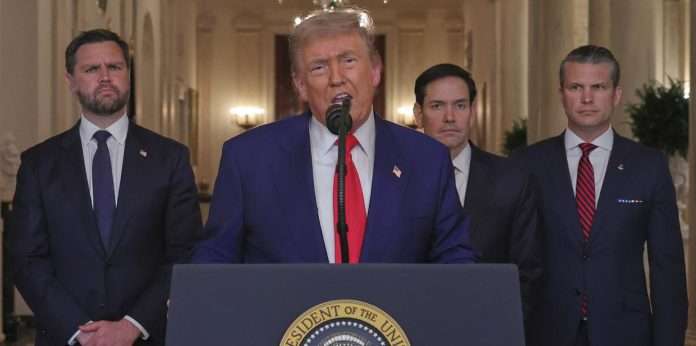
‘We’ve won’, ‘it’s over’: Trump has claimed victory in Iran war 12 times. So why is the conflict still continuing?
‘We’ve won’, ‘it’s over’: Trump has claimed victory in Iran war 12 times. So why is the conflict still continuing?
Trump’s statements, spread across speeches, interviews and social media posts, show a consistent pattern of declaring victory while simultaneously threatening escalation.
US President Donald Trump has repeatedly projected that the war is effectively finished, even as military operations continue.
JKSSB Fresh Divisional cadre Jobs Posts Advertised
More than a month into the conflict, US President Donald Trump has declared the Iran war “over” or close to ending at least a dozen times, according to a compilation of his public statements cited by Axios. Yet, on the ground, the war continues, Iran remains defiant, and there is no formal ceasefire or agreement in sight.
This widening gap between rhetoric and reality has become central to understanding the current phase of the conflict.
A dozen claims of victory
According to Axios, Trump has repeatedly projected that the war is effectively finished, even as military operations continue. His statements, spread across speeches, interviews and social media posts, show a consistent pattern of declaring victory while simultaneously threatening escalation.
On March 26, during a Cabinet meeting, Trump said Iran was “defeated, they can’t make a comeback.” Just two days earlier, on March 24, he told reporters, “We’ve won this war. This war has been won.”
🎓 Explore Jobs by Qualification
Explore the latest job opportunities in J&K and across India based on your educational qualification.
On March 23, he pointed to ongoing diplomacy, saying the US and Iran had “very good and productive conversations,” but added a warning that if talks failed, “we’ll just keep bombing our little hearts out.”
On March 13, he told Fox News the war would end when “I feel it in my bones,” while also suggesting it would not last long.
On March 12, he said Iran was near collapse, stating, “They are pretty much at the end of the line. It doesn’t mean we are going to end it immediately, it is only a question of when.”
A day earlier, on March 11, he told Axios the war would end “soon” because there was “practically nothing left to target,” adding it could finish “any time I want it to end.”
In remarks to an audience the same day, he said, “You never like to say too early you won. We won. In the first hour it was over.” He followed that with, “We don’t want to leave early, do we? We gotta finish the job, right?”
On March 9, speaking at the Republican Issues Conference, Trump said, “We’ve already won in many ways, but we haven’t won enough,” while also predicting the war would be over “very soon” and describing Iran as “all gone.”
Earlier, on March 2, he struck a similar tone, saying, “We will easily prevail. … Whatever it takes.” On the same day, he told ABC News, “Nobody else could have done this but me.”
More recently, Trump has paired claims of progress with direct threats. He warned that if the Strait of Hormuz is not reopened, the US would escalate, saying, “If the Hormuz Strait is not immediately ‘Open for Business’, we will conclude our lovely ‘stay’ in Iran” by targeting key infrastructure.
Recruitment in AIIMS Jammu, Check Details
Why the war has not ended
Despite these repeated declarations, the war continues because none of the defining conditions of an end have been met.
Iran has not surrendered. There is no ceasefire. There is no negotiated settlement. And there has been no regime change.
Instead, Tehran continues to project strength through missile strikes, regional proxies and its control over the Strait of Hormuz, a critical global energy route.
This creates a clear contradiction. While Washington claims victory, Iran continues to operate as an active and capable adversary.
Rhetoric versus strategy
Another reason the conflict persists is the mismatch between messaging and strategy. Trump’s statements alternate between declaring victory and threatening further escalation, suggesting that the US itself has not settled on a clear objective.
Is the goal regime change, deterrence or a negotiated deal? The answer remains unclear.
Analysts suggest that Trump’s messaging may also be aimed at influencing global oil markets and domestic political sentiment. By projecting success, the administration may be attempting to stabilise prices and reassure voters.
However, without concrete outcomes, such messaging does not translate into an actual end to the war.
What it would take to end the war
For the conflict to truly conclude, one of two outcomes is required.
The first is a negotiated settlement that addresses sanctions, Iran’s nuclear programme and maritime security, including reopening the Strait of Hormuz.
The second is a decisive shift on the battlefield that forces Iran to concede. Experts warn that this would likely require major escalation, including the possible deployment of ground forces, which carries significant risks.
A war that continues despite claims
For now, Trump’s repeated assertions, numbering at least a dozen, have not altered the reality on the ground.
The war continues. Iran remains defiant. And without a clear agreement or decisive outcome, the conflict is far from over, regardless of how often it is declared finished.