
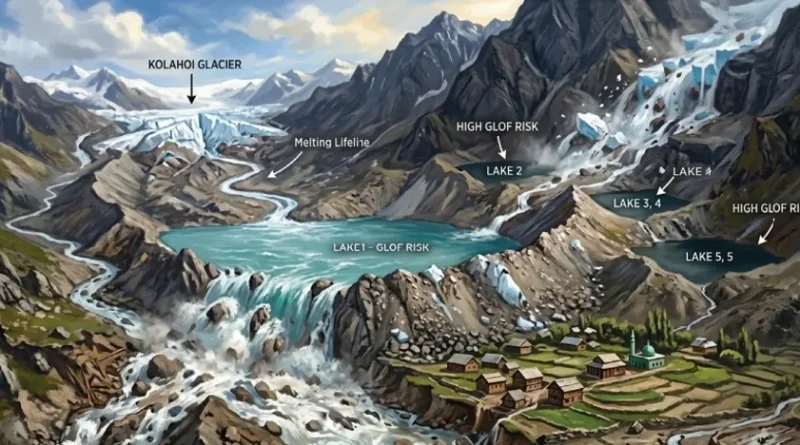
J&K on GLOF alert
J&K on GLOF alert
Srinagar, Sep 3: The Centre on Thursday reviewed the preparedness of Jammu and Kashmir and four Himalayan states for Glacial Lake Outburst Floods (GLOFs) and snow avalanches, focusing on vulnerable sites, early warning, evacuation and response.
The meeting came in the wake of the Nepal-Tibet glacier disaster that killed more than 1000 people and left over 2000 missing.
Union Home Secretary Govind Mohan chaired the meeting in New Delhi.
It was attended by the chief secretaries and State Disaster Management Authorities of J&K, Uttarakhand, Himachal Pradesh, Sikkim, and Arunachal Pradesh.
Senior officials from the Ministry of Home Affairs, National Disaster Management Authority, Central Water Commission, India Meteorological Department and Defence Geoinformatics Research Establishment also attended.
Officials reviewed vulnerable glacial lakes and snow-covered areas, high-risk locations and downstream flow paths, along with alert dissemination, evacuation plans and response resources.
The states and J&K presented measures for monitoring vulnerable lakes, mapping flow paths, issuing early warnings, reaching communities and deploying response resources.
🎓 Explore Jobs by Qualification
Explore the latest job opportunities in J&K and across India based on your educational qualification.
Mohan said vulnerable glacial lakes and avalanche-prone areas required “continuous and proactive monitoring,” particularly during periods of heightened risk.
He said state agencies, district administrations and scientific and technical institutions must coordinate so warnings are “acted upon promptly and effectively.”
“Preparedness for GLOFs and snow avalanches must move beyond response-oriented measures towards risk-informed planning, preventive mitigation and community-level preparedness,” Mohan said.
The states and J&K were asked to review their plans, identify gaps in warning and evacuation arrangements and address them in advance.
Union Home Secretary also directed authorities to expedite GLOF mitigation projects sanctioned by the Centre in 2024.
GLOF concerns are no longer confined to the eastern Himalayas.
Various recent studies indicate that retreating glaciers and newly formed glacial lakes could increase vulnerability in the central and western Himalayas.
The western Himalaya, including Himachal Pradesh, J&K and Ladakh, has recorded rising temperatures and declining snow cover, affecting glaciers and high-altitude water systems.
Within J&K, Ladakh and the Chenab valley face greater GLOF concern than the Kashmir valley, particularly in the upper Chenab catchments of Kishtwar and adjoining areas.
Retreating glaciers and moraine-dammed lakes in parts of Zanskar, Nubra and Shyok in Ladakh are among the areas of concern.
GLOF vulnerability is lower in the Kashmir valley, but studies have found that it remains susceptible to the particular hazard.
Experts caution that satellite imagery can track changes in lake size and surrounding terrain, but field investigations are needed to assess the stability of moraine dams and adjoining slopes.
GLOFs are distinct from ice-rock avalanches, or glacial-rock collapses, which can occur without a glacial lake.
The sudden failure of unstable ice and rock can send large volumes of debris into downstream valleys, making the hazard relevant across the Himalayas including J&K and Ladakh.
The distinction is important in the Nepal-Tibet disaster, which was linked to a glacier-rock collapse and debris flow rather than a conventional GLOF.
The event also generated a seismic signal equivalent to a magnitude 5.2 earthquake.