
J&K unemployment nearly double national average at 9.4%; youth joblessness at 26.2%: PLFS
J&K unemployment nearly double national average at 9.4%; youth joblessness at 26.2%: PLFS
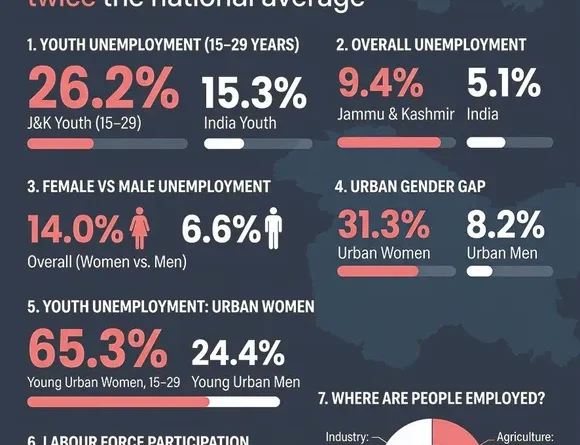
Srinagar, Nov 13: Jammu and Kashmir recorded an unemployment rate of 9.4 percent during July-September 2026, nearly twice the national average of 5.1 percent, while unemployment among young people aged 15-29 stood at 26.2 percent, highlighting the continuing employment challenge in the Union Territory, according to the latest Periodic Labour Force Survey (PLFS).
The Quarterly Bulletin of the PLFS for July-September 2026, released by the Ministry of Statistics and Programme Implementation, shows that unemployment in J&K remains considerably higher than the national average across both rural and urban areas, with women and young people facing a particularly difficult situation in the labour market.
The unemployment rate among persons aged 15 years and above in J&K stood at 9.4 percent, against 5.1 percent at the all-India level.
The gap was particularly pronounced in urban areas, where the rate reached 14.1 percent, compared with 8.3 percent in rural areas.
The gender-wise figures reveal an equally sharp disparity.
Female unemployment in J&K stood at 14 percent, more than twice the male unemployment rate of 6.6 percent.
In rural areas, unemployment among women was 11.5 percent against 6.2 per cent among men.
🎓 Explore Jobs by Qualification
Explore the latest job opportunities in J&K and across India based on your educational qualification.
In urban areas, the gap widened substantially, with female unemployment reaching 31.3 percent compared with 8.2 percent among men.
The situation is particularly concerning among the youth.
The unemployment rate for the 15-29 age group was 26.2 percent in J&K, against the national average of 15.3 percent.
The rate was 24.3 percent in rural areas and 35.8 percent in urban areas.
Among young women, unemployment stood at 38 per cent across rural and urban areas, compared with 19.4 percent among young men.
The urban gender gap was especially pronounced.
Unemployment among urban women aged 15-29 reached 65.3 percent, against 24.4 percent among urban men.
In rural areas, the corresponding rates were 34 percent for women and 18.3 percent for men.
The figures indicate that the employment challenge is not confined to the overall availability of jobs but is also marked by significant differences across gender, age and location.
Despite the high unemployment rate, J&K recorded a Labour Force Participation Rate (LFPR) of 60.5 percent among persons aged 15 years and above, higher than the national average of 55.5 percent.
The LFPR measures the proportion of the population that is either employed or seeking and available for work.
In J&K, the rate was 75.4 percent among men and 45.5 per cent among women.
The rural LFPR stood at 62.5 percent, compared with 53.1 percent in urban areas. The gender gap was visible in both segments: rural male participation was 75.3 percent against 49.8 percent among women, while in urban areas the corresponding rates were 75.8 percent and 28.3 percent.
The Worker Population Ratio (WPR), which measures the proportion of the population that is employed, stood at 54.9 percent in J&K against 52.7 percent nationally.
The WPR was 70.4 percent among men and 39.1 percent among women. In rural areas, it stood at 57.3 percent, while the urban ratio was 45.6 percent.
Among young people aged 15-29, the WPR in J&K was 35.3 percent, compared with 34.9 percent nationally.
The youth WPR was 47.6 percent among men and 22.3 percent among women.
The survey’s industry-wise distribution of employed persons presents another important dimension of J&K’s employment structure.
Agriculture continued to be the largest source of employment, accounting for 39.1 percent of all employed persons aged 15 years and above.
The secondary sector, including manufacturing, construction, mining and quarrying, accounted for 27.3 percent, while the tertiary or services sector contributed 33.6 percent.
The dependence on agriculture was considerably higher among women.
As many as 74.6 percent of employed women in J&K were engaged in agriculture, compared with 19.5 percent of employed men.
Among employed men, the services sector accounted for 44.5 percent and the secondary sector for 35.9 percent.
For women, the corresponding shares were only 13.7 percent and 11.7 percent.
The rural employment structure was more heavily dependent on agriculture, which accounted for 44.5 percent of employed persons.
The secondary sector contributed 28.1 percent and services 27.4 percent.
In urban areas, the employment pattern was markedly different.
Services accounted for 63.4 percent of employment, followed by the secondary sector at 23.6 percent and agriculture at 12.9 percent.
The gender divide was also evident in the urban employment structure.
Among employed urban women, 49.6 percent were in services and 36.9 percent in agriculture, while 13.5 percent were in the secondary sector.
The state-wise figures show that J&K’s overall unemployment rate of 9.4 percent was higher than the rates recorded in the other states and Union Territories included in the bulletin.
Kerala recorded 8.7 percent, Punjab 7.8 percent and Himachal Pradesh 5.9 percent.
In the youth category, however, J&K’s unemployment rate of 26.2 percent was among the highest.
Kerala recorded 28.9 percent and Himachal Pradesh 26.4 percent.
The all-India unemployment rate for the 15-29 age group was 15.3 percent, with the rural rate at 13.6 percent and the urban rate at 18.9 percent.
The PLFS estimates are based on the Current Weekly Status (CWS) approach. Under this measure, a person is considered unemployed if they did not work even for one hour on any day during the reference week but sought or were available for work for at least one hour on any day during that week.
The survey covered 198 first-stage units in Jammu and Kashmir and 2373 households, with 10,713 persons surveyed during the July-September 2026 quarter.