
Contents
All about Ali Khamenei’s family: Who is dead, who is alive; Could Mojtaba become Iran’s next supreme leader?
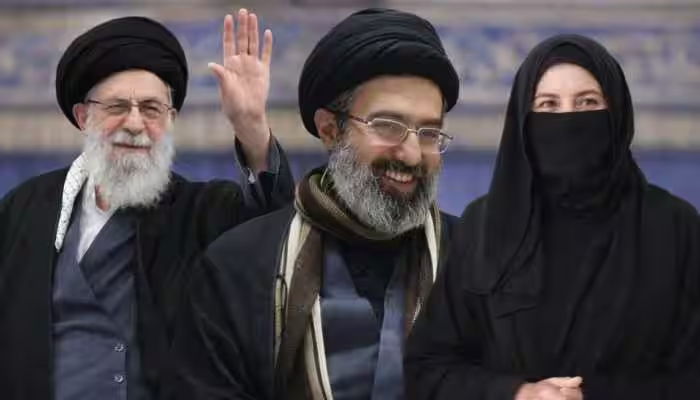
Ali Khamenei’s family: Khamenei was married to Mansoureh Khojasteh Bagherzadeh. The couple had six children – Mostafa, Mojtaba, Masoud; details of the others are not publicly available.
Ayatollah Ali Khamenei, Iran’s Supreme Leader since 1989, died on February 27 at the age of 86 following a joint U.S.–Israeli airstrike, Iranian state media and international news agencies have reported. His death marks the end of nearly four decades in power, during which he shaped Iran’s domestic and foreign policy and held ultimate authority over the state, military, judiciary, and security forces
As Supreme Leader, Khamenei was the most powerful figure in Iran’s political system. His role surpassed that of presidents and lawmakers, making him the final authority on key national decisions.
Khamenei was married to Mansoureh Khojasteh Bagherzadeh, who served as the spouse of the Supreme Leader from 1989 until his death. The couple had six children – Mostafa, Mojtaba, Masoud; details of the others are not publicly available.
At this moment, his son-in-law and daughter-in-law have been killed in US-Israel strikes. However, unverified social media claims suggesting his son Mojtaba is also killed should not be treated as confirmed.
Best scholarships for J&K students after 12th
Who is Mojtaba Khamenei?
Mojtaba Khamenei is one of Ali Khamenei’s sons. He is a cleric by training and has been widely discussed in analyses of Iran’s power structure because of his informal influence within the regime, especially among hardline security circles.
Despite this influence, Mojtaba has never held a formal political office within Iran’s government, and under the country’s constitution, the next Supreme Leader must be elected by the Assembly of Experts, a body of clerics entrusted with choosing the leader.
Reports from credible sources before Khamenei’s death indicated that he was not officially listed among the top potential successors named by Khamenei’s inner advisers, even though he was considered a possible candidate due to close ties to powerful factions like the Islamic Revolutionary Guard Corps (IRGC).
Could Mojtaba become Iran’s next leader?
Mojtaba’s path to leadership is uncertain and complex. Constitutionally, a successor must meet specific religious and political criteria and be chosen by the Assembly of Experts. While his name has surfaced in discussions, there is no formal confirmation that he will be appointed Supreme Leader.
Some reports claim his influence behind the scenes – particularly with the IRGC – gives him a possible advantage, but opposition within clerical circles and Iran’s traditional norms against hereditary succession make his rise far from guaranteed.
As Iran begins the official process to select a new leader, all eyes will be on the Assembly of Experts and its deliberations – a moment that could shape the country’s future direction after decades under Khamenei’s rule.