
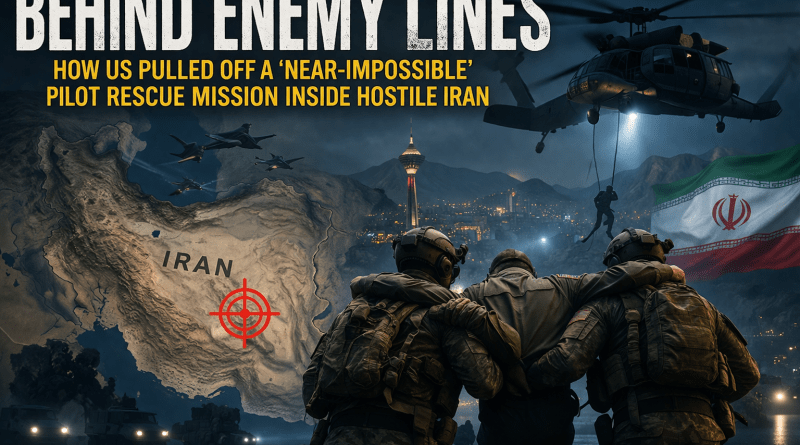
Behind Enemy Lines: How US pulled off a ‘near-impossible’ pilot rescue mission inside hostile Iran
The operation involved hundreds of special forces troops, dozens of aircraft and helicopters, and integrated intelligence support across multiple domains
US airman rescued after F-15E jet shot down over Iran
US forces raced Iranian troops to extract the stranded airman
All US personnel evacuated safely after complex rescue mission
Recruitment in Jammu Public School
2) Re-opening of link for online submission of Registration Retu
A US fighter jet shoots out of the sky over hostile territory. Two crew members eject into the darkness. One of them quickly disappears into rugged mountains while enemy forces close in from all sides.
Except there are no cameras rolling. This is real-world warfare.
Because what followed was not fiction; it was a sprawling, high-risk special operations mission deep inside conflict-struck Iran that military leaders would later describe as “one of the most challenging and complex in the history of US special operations
How it all began…
The operation began when an F-15E fighter jet was struck by Iranian fire over Iranian territory earlier this week, forcing both crew members to eject.
One pilot was recovered within hours. The second crew member, a weapons systems officer (WSO), survived but was injured and stranded in mountainous terrain with only minimal survival gear.
Despite the hostile environment, the airman was not entirely isolated. According to officials, he carried a beacon and a secure communications device that continuously transmitted his position back to US command centres.
The WSО, reportedly injured but mobile, used SERE (Survival, Evasion, Resistance and Escape) training to evade capture, moving away from the wreckage, taking cover on elevated ground, and activating the emergency beacon.
That tracking capability became the backbone of the rescue effort.
The ‘race’ between two militaries
What followed was not just a rescue mission; it was a race. Against time and all odds.
US forces quickly moved to locate and extract the airman while Iran’s Islamic Revolutionary Guard Corps (IRGC) launched parallel search efforts in the same mountainous region of southwest Iran.
Officials cited by Axios said both sides were closing in on the same zone, turning the operation into a high-stakes contest of speed, intelligence, and firepower.
To prevent Iranian forces from reaching the survivor, US aircraft carried out strikes on approaching convoys. One official described it as a “hail of heavy fire” used to clear access routes and secure the extraction corridor.
At the same time, intelligence assets, including cyber and space support, helped guide real-time positioning as commanders monitored the operation from Washington, including from the White House Situation Room, where President Donald Trump reportedly followed developments closely.
Once the airman was located, US special operations forces launched a full-scale extraction mission.
The operation involved hundreds of special forces troops, dozens of aircraft and helicopters, and integrated intelligence support across multiple domains, reports The New York Times.
U.S. attack aircraft dropped bombs and opened fire on Iranian convoys attempting to approach the location where the airman was hiding. As forces converged, a firefight soon erupted on the ground.
Two former senior military officials briefed on the operation told the Times that the engagement escalated rapidly as US troops closed in on the survivor.
A senior US military official described the mission as “one of the most challenging and complex in the history of US special operations.”
Unlike typical hostage or downed-pilot recoveries, which are usually executed quickly at night, officials said this operation stretched into daylight, increasing the risk of detection and engagement.
The ‘Deception’ point
Moreover, US intelligence services added another layer to the operation – deception.
A senior administration official, cited by the Air & Space Forces Magazine, said the CIA spread false information inside Iran suggesting US forces had already located and extracted the airman, in an effort to confuse Iranian search teams and disrupt coordination.
At the same time, US MQ-9 Reaper drones reportedly engaged hostile personnel approaching the extraction zone, striking individuals assessed as threats within close range of the survivor.
In the meantime, IRGC and Basij units were actively involved in the search, with unverified footage circulating online purporting to show casualties among Iranian personnel.
The mission expanded into a multi-domain CSAR effort involving Air Force Pararescuemen (PJs), special operations forces, and aviation assets operating under contested conditions. An A-10 Thunderbolt II provided cover for rescue teams but later crashed in Kuwait after being damaged; the pilot ejected safely and was recovered.
The aviator, officials confirmed, had been evading capture for nearly two days before being recovered.
“The CIA then helped find the Airmen, and Trump decided to launch the rescue mission,” a senior administration official told Air & Space Forces Magazine.
Even after the airman was reached, the mission faced an unexpected logistical failure.
Two transport aircraft positioned for extraction became stuck at a remote Iranian base. Commanders responded by sending replacement aircraft and ultimately destroying the disabled planes to prevent their capture.
All US personnel were eventually evacuated successfully, officials said.
Officials also confirmed a second, earlier rescue operation involving the pilot, who was extracted within hours of the shootdown on April 3.
That operation reportedly involved additional complications, including Iranian fire damaging a Black Hawk helicopter and an A-10 aircraft, though both missions ultimately succeeded.
The earlier rescue was kept secret to avoid jeo pardising the second extraction, revealed Trump on Sunday.
“This miraculous Search and Rescue Operation comes in addition to a successful rescue of another brave Pilot, yesterday,” Trump said, explaining the delayed disclosure.
Military analysts and officials quoted across US outlets noted that the mission combined nearly every element of modern warfare — stealth intelligence, electronic tracking, air superiority operations, ground combat, and deception campaigns.
The terrain, described as mountainous and isolated, combined with active enemy pursuit and long-duration engagement made the operation particularly dangerous.
Retired generals told CNN that the airman was effectively operating with minimal supplies, exposed in hostile territory, while being actively hunted.
The rescue unfolded amid escalating military tensions in the region, including contested airspace operations and multiple aircraft losses.
According to Air & Space Forces Magazine, Iran downed multiple US aircraft during the broader conflict, including the F-15E involved in the shootdown and earlier engagements involving an A-10 Thunderbolt II and rescue helicopters.
Despite these losses, US officials emphasised that all rescue personnel returned safely, framing the operation as a rare successful extraction under extreme combat conditions.