
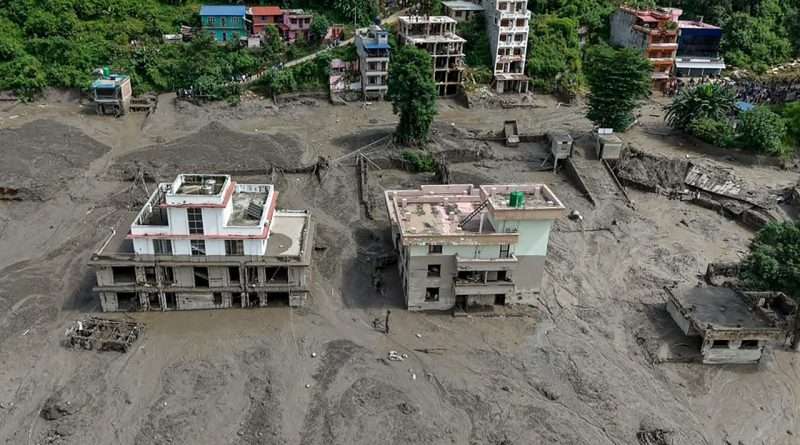
Nepal floods: Death toll hits 160, over 130 Indians missing; helicopters unable to land
Nepal floods: Death toll hits 160, over 130 Indians missing; helicopters unable to land
Nepali police said they had recovered 157 bodies following the disaster, while Chinese state media reported three deaths from a mudslide at a border hub in Tibet. It also reported 265 people missing.
The devastating flood and landslide along the Nepal-Tibet border have killed at least 160 people and left hundreds unaccounted for, with rescue teams combing through mud and debris for survivors.
Nepali police said they had recovered 157 bodies following the disaster, while Chinese state media reported three deaths from a mudslide at a border hub in Tibet. It also reported 265 people missing.
The scale of the destruction has left entire communities struggling to recover. David Fisher, Nepal head of the International Federation of Red Cross and Red Crescent Societies (IFRC), said “entire villages and market areas have been wiped out”. The organisation is sending emergency supplies, including blankets, first-aid kits, stretchers and body bags.
Prime Minister Narendra Modi, on Wednesday, spoke to Nepal Prime Minister Balendra Shah and conveyed his condolences over the loss of lives caused by floods in the neighbouring country.
“Spoke to Prime Minister Balendra Shah and conveyed condolences on the loss of lives due to the floods in Nepal. The people of India stand in solidarity with their sisters and brothers in Nepal at this difficult time. India is ready to provide all possible humanitarian assistance to Nepal. Our teams are coordinating closely on rescue and relief efforts @PM_nepal_ @ShahBalen,” said PM Modi in a post on X.
The Indian embassy in Nepal has issued emergency numbers for Indian nationals.
🎓 Explore Jobs by Qualification
Explore the latest job opportunities in J&K and across India based on your educational qualification.
The disaster has also affected hundreds of tourists.
Nepal’s tourism authorities said 403 travellers were unaccounted for in the hours following the flooding, including 341 foreigners.
Among the foreign nationals reported missing were 130+ Indians, along with citizens of Australia, Britain, Malaysia, the Netherlands, Portugal, South Africa, South Korea and the U.S.
At least 59 of the Indians were pilgrims for the Kailash Manasarovar Yatra, Samrat Tours and Travel agency said.
Rescue operations in Nepal’s flood-ravaged Rasuwa district faced fresh hurdles on Thursday, with helicopters unable to land in some of the worst-hit areas because of high water levels, Reuters reported, citing officials who warned that the casualty count could rise.
The worst affected locations include Syapru Besi and Timure, near the Nepal-China border. Rasuwa, a mountainous district with a population of around 50,000, has suffered extensive damage after a sudden surge of water swept through settlements and market areas.
“There has been great damage to the settlement and market area. The exact details of the flood damage have not yet been received,” Rasuwa Chief District Officer Narendra Pariyar told ANI.
Pariyar said the sudden nature of the flooding had made its cause difficult to establish.
“It has not rained here. The sun is shining here. It is not clear whether the glacier burst upstream or what happened. The flood was sudden,” he said.
More than 105 Indians are among those reported missing following the disaster, according to the latest reports. The situation has also prompted authorities in India’s Uttar Pradesh and Bihar to issue alerts for areas close to the Nepal border amid concerns over rising river levels.
The floods and landslides have killed at least 160 people, according to the latest figure from AFP, while several hundred remain missing. Nepali police said they had recovered 157 bodies, while Chinese state media reported three deaths linked to a mudslide at a border hub in Tibet.
The Nepali Army has deployed helicopters as part of the rescue effort, although difficult conditions have prevented aircraft from landing in some of the hardest-hit locations. Ground teams are continuing to search through mud and debris and evacuate people from vulnerable areas.
Across the border, a mudslide originating from the Nepal side caused “major casualties” and left people missing at the Gyirong Port in Tibet, according to Chinese state media.
The incident disrupted roads, communications and electricity supplies in the Shigatse region. CCTV footage showed floodwater carrying branches and debris across a road, although the footage could not be independently verified.
Chinese President Xi Jinping ordered an “all-out” rescue operation, calling for authorities to prioritise finding missing people, treating the injured and limiting further casualties. Chinese state media did not provide a death or injury figure for the Tibet side.
The Gyirong Port has experienced similar disasters in the past. In July, 17 people were reported missing following a mudslide near the trading hub, Xinhua reported.
Nepal’s health authorities are preparing additional medical support for flood-hit communities.
The World Health Organization will send essential medicines, medical equipment and 15 emergency tents to affected areas along the Bhotekoshi River in Rasuwa, Kantipur reported, citing the Health Ministry.
The ministry has also set aside 100 emergency beds at Bir Hospital and the Trauma Centre in Kathmandu. Three injured people have so far been evacuated to the capital.
Telecom operator Ncell will provide affected customers in Rasuwa and Nuwakot with free data, voice services and 100 SMS messages for three days, Kantipur reported.
More than 25 Ncell towers and sites have been knocked out after landslides damaged optical-fibre connections and disrupted power supplies.
The cause of the sudden surge remains uncertain.
Nepal Foreign Minister Shishir Khanal has said an earthquake may have triggered a landslide that blocked a river, eventually sending a large volume of water downstream.
Nepal’s disaster management authority has said satellite data pointed to a possible “snow-rock landslide” near the Nepal-China border.
Scientists at the International Centre for Integrated Mountain Development (ICIMOD) are also examining whether an ice-rock avalanche may have triggered the flooding.
“We believe a rock-ice avalanche occurred in Nepal, blocking the Lhende river and causing the cascading flood event,” Sarthak Shrestha, a remote-sensing and geoinformation analyst at ICIMOD, told AFP.
Shrestha said the group’s preliminary assessment found “no anomalies” on the Chinese side of the border.
Authorities are concerned that the disaster could trigger further flooding if debris blocking the river upstream shifts or collapses.
“With a blockage still lodged upstream on the Nepal-China border river, authorities warn a second flood may occur,” Qianggong Zhang, head of climate and environmental risks at ICIMOD, told AFP.
The Nepal Electricity Authority said around 430 MW of generation capacity from hydropower and solar facilities had been damaged, disrupting electricity supplies.
Prime Minister Balendra Shah has promised a full government response and urged affected communities to remain patient as rescue and relief operations continue. “The pain and loss you have suffered is not small,” Shah said in a social media statement. “But I want to assure you that you are not alone in this difficult time.”
The disaster comes during the South Asian monsoon, when heavy rainfall frequently triggers floods and landslides.