
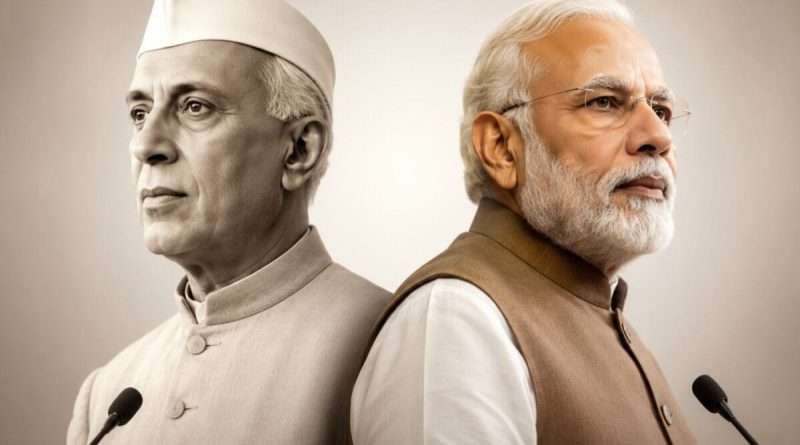
PM Modi to surpass Nehru’s record
PM Modi to surpass Nehru’s record
PM Modi to surpass Nehru’s record as longest continuously serving elected PM
As numbers go, 4,399 may not appear significant in itself except to mathematicians who may find values of oddness and evenness around it. For political observers, however, the number marks a high watershed moment in the history of post-independent India, when Prime Minister Narendra Modi became the longest continuously serving person in that post.
On June 10th, Prime Minister Modi will be crossing the record set by India’s first Prime Minister, Jawaharlal Nehru, who was first elected to the post in 1952 (his previous stint from 1947-52 was as head of an interim government as elections were yet to be institutionalised and held). Indira Gandhi had a fractured tenure totalling 14 years, the unbroken tenure of Prime Minister Modi for 12 years or in this case 4,399 days, therefore calls for closer examination.
According to Ajay Singh, former press secretary to Presidents Ram Nath Kovind and President Murmu, “milestones do not define an epoch of transformation.”
Recruitment in Army Public School, Udhampur
“The milestone of surpassing the record of former prime minister Nehru is remarkable, yet Prime Minister Modi will be remembered less for statistics and more for reimagining India’s politics in the most profound way. In his tenure, issues that had bedevilled the country for decades — the construction of the Ram temple at Ayodhya, the attenuation of Article 370 in Jammu and Kashmir as an irrelevant relic of the past, the taming of insurgency in the northeastern states, and the decimation of the menacing Naxalite movement — were finally consigned to the pages of history. In the arena of power politics, he stands, without question, as the most consequential and transformative leader in post-independence India,” said Mr. Singh.
The idea of a profound change in the way politics is done and articulated in the country, after a long, almost “Nehruvian” status quo, is a point that political scientist Ashwani Kumar also makes.
“In contrast to Jawaharlal Nehru, the nation-builder; Margaret Thatcher, the market reformer; Nelson Mandela, the reconciler; and Lee Kuan Yew, the developmental moderniser, Prime Minister Narendra Modi has emerged as a civilizational moderniser and a principal architect of what many regard as India’s Second Republic,” says Prof. Kumar.
🎓 Explore Jobs by Qualification
Explore the latest job opportunities in J&K and across India based on your educational qualification.
In political-sociological terms, he says, Prime Minister Modi represents a post-Weberian mass leader whose authority derives not merely from electoral success but from his capacity to reconfigure the moral and symbolic foundations of democratic politics. “His leadership seeks to transform governance from a predominantly managerial enterprise into a participatory project of national renewal, anchored in a shared sense of purpose, identity, and civilizational continuity,” he said.
Mr. Singh argues that while comparisons between prime ministers are redundant due to the fact that they are products of a specific historical context, Prime Minister Modi’s years at the helm of affairs have to be acknowledged as one where many of the givens of Indian politics were shattered.
District Hospital Ramban Recruitment 2026
The NDA Government, led by Prime Minister Modi, is currently marking 12 years of power this week.
The milestone of 4,399 days as Prime Minister is somehow subsumed within that. History will likely have a better view on what his tenure has meant, but even in the midst of it, there is no denying that he has broken many hoary chestnuts of Indian politics, that India is in a specific political era, different from before.