

Trade Setup for June 29: Top 15 things to know before the opening bell
Trade Setup for June 29: Top 15 things to know before the opening bell
As long as the Nifty 50 trades below 24,200, the consolidation may continue, with crucial support placed at 23,800–23,750. However, a convincing and sustained close above the 24,200 zone could help the index achieve the next key resistance zone of 24,500–24,600, according to experts.
As long as Nifty 50 trades below this 24,200, consolidation may continue with crucial support placed at 23,800–23,750
Convincing close above 24,200 zone could help Nifty 50 achieve next key resistance zone of 24,500–24,600
Experts signal caution following fresh tensions in the Strait of Hormuz
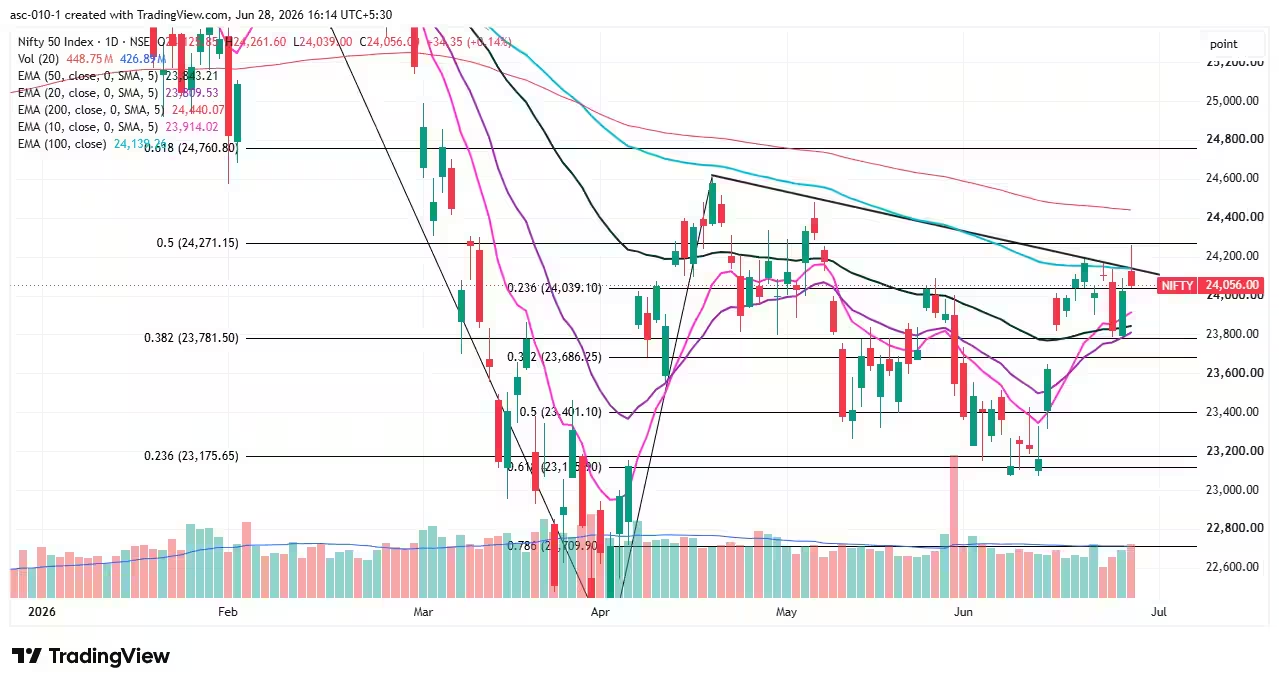
The Nifty 50 closed off the day’s high with moderate gains due to profit booking in the second half on June 25, despite subdued oil prices and lower VIX levels. The 24,100–24,200 zone appears to be a key hurdle for the Nifty 50 on the upside, as it failed to sustain above this level on a closing basis last week. As long as the index trades below this zone, the consolidation may continue, with crucial support placed at 23,800–23,750. However, a convincing and sustained close above the 24,100–24,200 zone could help the index achieve the next key resistance zone of 24,500–24,600, paving the way for a move towards 24,800, according to experts. They also signalled caution following fresh tensions in the Strait of Hormuz.
Here are 15 data points we have collated to help you spot profitable trades:
🎓 Explore Jobs by Qualification
Explore the latest job opportunities in J&K and across India based on your educational qualification.
1) Key Levels For The Nifty 50 (24,056)
Resistance based on pivot points: 24,204, 24,256, and 24,341
Support based on pivot points: 24,034, 23,981, and 23,896
Special Formation: The Nifty 50 formed a small bearish candle with a long upper shadow on the daily charts, signalling rejection for the bulls at the crucial overhead resistance. The index failed to hold above the falling resistance trendline (adjoining the April 21 high and June 18 high) on a closing basis. It also could not sustain above the 100-day EMA on a closing basis but remained well above the short- and medium-term moving averages, which continued to trend upward. The momentum indicators signalled consolidation, as the RSI remained sideways at 56.97 despite a positive crossover. Meanwhile, the gap between the MACD and the signal line narrowed further, as reflected by the shrinking green histogram bar for the fifth consecutive session. All this indicates continued consolidation with a positive underlying bias, although a decisive breakout above the resistance zone is needed to trigger the next leg of the rally.
Job Fair 2026 at District Employment & Counselling Centre, Budgam
2) Key Levels For The Bank Nifty (58,177)
Resistance based on pivot points: 58,559, 58,699, and 58,927
Support based on pivot points: 58,103, 57,963, and 57,735
Resistance based on Fibonacci retracement: 59,195, 61,678
Support based on Fibonacci retracement: 57,332, 56,465
Special Formation: The Bank Nifty closed off the day’s high with gains of 27 points and formed a red candle with a sizeable upper shadow on the daily timeframe, signalling profit booking at higher levels. Despite this profit booking, the overall trend remained positive, as the banking index traded well above all key moving averages, with the short-term moving averages sustaining above the medium- and long-term moving averages. The RSI rose to 66.60 with a bullish crossover, while the gap between the MACD and the signal line narrowed further, reflected in the shrinking green histogram bar for the fifth consecutive session. All this indicates that the broader trend remains positive, although momentum has moderated and some consolidation or range-bound movement may continue in the near term.
3) Nifty Call Options Data
According to the monthly options data, the maximum Call open interest was seen at the 24,500 strike (with 1.18 crore contracts). This level can act as a key resistance level for the Nifty in the short term. It was followed by the 24,200 strike (1.02 crore contracts) and 24,000 strike (86.3 lakh contracts).
Maximum Call writing was observed at the 24,200 strike, which saw an addition of 40.57 lakh contracts, followed by the 24,800 and 24,250 strikes, which added 26.16 lakh and 24.05 lakh contracts, respectively. The maximum Call unwinding was seen at the 24,000 strike, which shed 17.62 lakh contracts, followed by the 23,950 and 23,800 strikes, which shed 7.94 lakh and 7.16 lakh contracts, respectively.
4) Nifty Put Options Data
On the Put side, the 24,000 strike holds the maximum Put open interest (with 1.25 crore contracts), which can act as a key support level for the Nifty in the short term. It was followed by the 23,500 strike (1.09 crore contracts) and the 23,800 strike (73.22 lakh contracts).
The maximum Put writing was placed at the 24,100 strike, which saw an addition of 29.9 lakh contracts, followed by the 24,200 and 24,150 strikes, which added 29.43 lakh and 13.96 lakh contracts, respectively. The maximum Put unwinding was seen at the 23,400 strike, which shed 18.38 lakh contracts, followed by the 23,700 and 23,900 strikes, which shed 13.42 lakh and 12.94 lakh contracts, respectively.
5) Bank Nifty Call Options Data
According to the monthly options data, the maximum Call open interest was seen at the 59,000 strike, with 10.07 lakh contracts. This can act as a key resistance level for the index in the short term. It was followed by the 58,500 strike (8.63 lakh contracts) and the 58,000 strike (7.96 lakh contracts).
Maximum Call writing was observed at the 58,500 strike (with the addition of 3.32 lakh contracts), followed by the 58,600 strike (1.36 lakh contracts) and 59,600 strike (1.33 lakh contracts). The maximum Call unwinding was seen at the 58,000 strike, which shed 3.95 lakh contracts, followed by the 58,100 and 57,500 strikes, which shed 1.88 lakh and 1.34 lakh contracts, respectively.
6560+ Posts: RRB Recruitment 2026
6) Bank Nifty Put Options Data
On the Put side, the 58,000 strike holds the maximum Put open interest (with 10.07 lakh contracts), which can act as a key support level for the index in the short term. This was followed by the 57,000 strike (9.24 lakh contracts) and the 57,500 strike (7.4 lakh contracts).
The maximum Put writing was placed at the 58,500 strike (which added 3.99 lakh contracts), followed by the 58,400 strike (1.5 lakh contracts) and 58,300 strike (99,840 contracts). The maximum Put unwinding was seen at the 57,500 strike, which shed 1.44 lakh contracts, followed by the 58,100 and 58,000 strikes, which shed 1.23 and 1.12 lakh contracts, respectively.
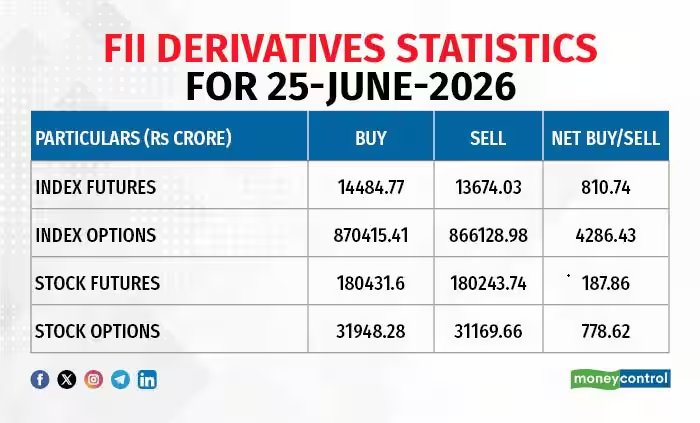
7) Funds Flow (Rs crore)
8) Put-Call Ratio
The Nifty Put-Call ratio (PCR), which indicates the mood of the market, fell to 1.06 on June 25, from 1.21 compared to previous session.
The increasing PCR, or being higher than 0.7 or surpassing 1, means traders are selling more Put options than Call options, which generally indicates the firming up of a bullish sentiment in the market. If the ratio falls below 0.7 or moves towards 0.5, then it indicates selling in Calls is higher than selling in Puts, reflecting a bearish mood in the market.
9) India VIX
The India VIX, the fear gauge, remained near lower levels and below all key moving averages, declining 2.5 percent to 13.05, which provided comfort to the bulls. A decisive fall below the 12 mark could provide even greater confidence to the bulls.
10) Long Build-up (34 Stocks)
A long build-up was seen in 34 stocks. An increase in open interest (OI) and price indicates a build-up of long positions.
11) Long Unwinding (58 Stocks)
58 stocks saw a decline in open interest (OI) along with a fall in price, indicating long unwinding.
12) Short Build-up (85 Stocks)
85 stocks saw an increase in OI along with a fall in price, indicating a build-up of short positions.
13) Short-Covering (38 Stocks)
38 stocks saw short-covering, meaning a decrease in OI, along with a price increase.
14) High Delivery Trades
Here are the stocks that saw a high share of delivery trades. A high share of delivery reflects investing (as opposed to trading) interest in a stock.
15) Stocks Under F&O Ban
Securities banned under the F&O segment include companies where derivative contracts cross 95 percent of the market-wide position limit.
Stocks added to F&O ban: Nil
Stocks retained in F&O ban: Nil
Stocks removed from F&O ban: Nil
Join JK Updates WhatsApp Channel