
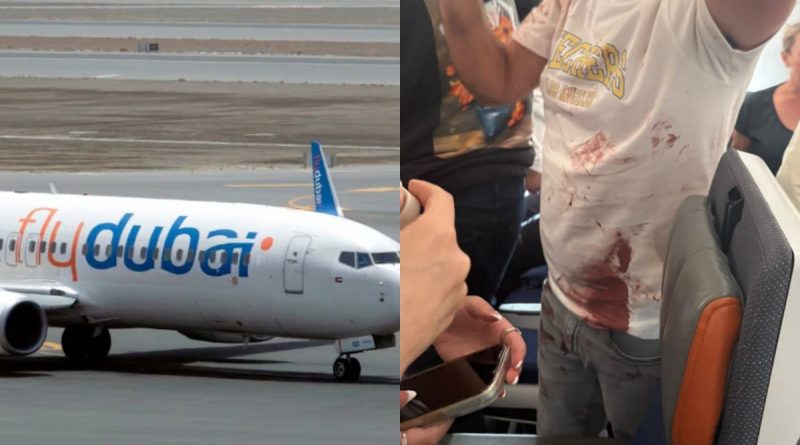
Pilot allegedly tried to crash plane, hijack code triggered, jets scrambled: What happened on Dubai-Tel Aviv flight
Pilot allegedly tried to crash plane, hijack code triggered, jets scrambled: What happened on Dubai-Tel Aviv flight
The emergency transmissions had prompted Israel to scramble fighter jets amid initial fears that the aircraft had been hijacked. (AFP)
A Flydubai flight from Dubai to Tel Aviv was diverted to Tabuk in Saudi Arabia on Wednesday after an onboard security incident that triggered emergency signals and a sharp drop in altitude.
Flight FZ1073, a Boeing 737 MAX 8 with registration A6-FKF, was flying towards Tel Aviv when the aircraft experienced significant altitude fluctuations. It later landed safely at Tabuk Regional Airport.
Flydubai confirmed that the aircraft landed safely and that passengers were accounted for, while authorities continued to investigate the incident.
Here is the minute-by-minute sequence based on the Flight Radar information.
03:05 — Take-off from Dubai
Flydubai flight FZ1073 took off from Dubai at 03:05 UTC. The Boeing 737 MAX 8 was headed towards Tel Aviv.
The aircraft was carrying passengers on the Dubai-Tel Aviv route when the incident unfolded during the flight.
05:21 — Altitude fluctuations begin
🎓 Explore Jobs by Qualification
Explore the latest job opportunities in J&K and across India based on your educational qualification.
At around 05:21 UTC, the aircraft began showing significant fluctuations in altitude.
The situation escalated a minute later, with the aircraft experiencing a sharp descent.
05:22 — Aircraft drops more than 14,000 feet
At 05:22 UTC, the aircraft dropped more than 14,000 feet in less than 30 seconds, according to the flight information supplied.
The aircraft plunged from around 30,000 feet to approximately 15,000 feet, according to reports. Flight-tracking data also showed a sudden descent of roughly 14,000 feet.
The sharp drop raised concerns about what was happening inside the aircraft.
05:31 — General emergency signal
At 05:31 UTC, the aircraft’s transponder code changed to 7700, the internationally recognised signal for a general emergency.
The signal indicated that the aircraft was dealing with an emergency situation.
05:38 — ‘7500’ hijack alert
Seven minutes later, at 05:38 UTC, the aircraft’s squawk code changed to 7500.
Code 7500 is the internationally recognised signal for unlawful interference or a suspected hijacking.
The transmission triggered concerns that the aircraft could have been hijacked. However, subsequent reports said the alert was linked to an altercation between the two pilots rather than an external hijacking. Reuters reported that an Israeli official said the incident was a physical altercation between the pilots and not a hijacking.
What happened inside the cockpit?
Israeli security media reported that the hijack alert was triggered after an altercation between the two pilots.
Reports cited by Israeli media alleged that the co-pilot stabbed the captain repeatedly during the incident. An eyewitness account attributed to Yasmin Abu Kasis, whose daughter Miriam was a passenger, described seeing a man with a knife attacking the pilot amid screaming.
“There was blood everywhere,” Abu Kasis said, according to reports.
Israeli authorities initially treated the incident as a potential terror attack, with reports suggesting that there were fears the aircraft could have been deliberately crashed.
The pilot at the centre of the incident was reported to be an Omani citizen, while the other pilot was a citizen of the United Arab Emirates.
Around 06:45 — Safe landing in Tabuk
At around 06:45 UTC, the aircraft landed at Tabuk Regional Airport in Saudi Arabia.