
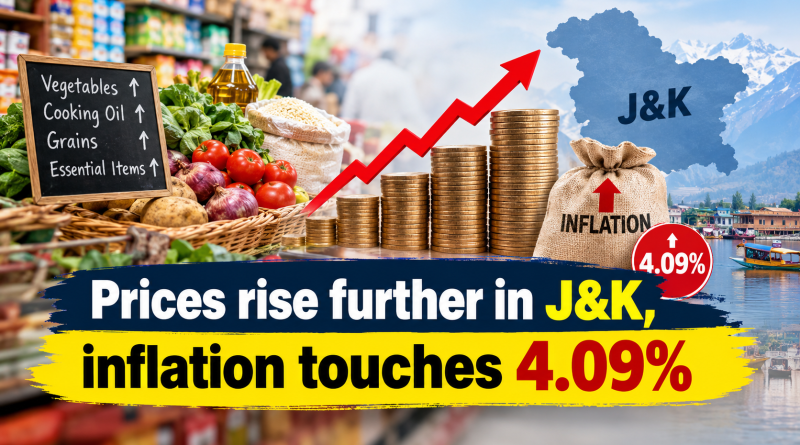
Prices rise further in J&K, inflation touches 4.09%
Prices rise further in J&K, inflation touches 4.09%
The rising cost of vegetables, pulses, poultry, and other essential commodities is putting increasing pressure on household budgets in Jammu and Kashmir, as the Union Territory’s inflation rate climbed to 4.09 percent in August, according to figures released by the Union Ministry of Statistics and Programme Implementation (MoSPI).
Inflation means a simple thing: the same amount of money buys fewer goods than it did earlier.
When prices of food and other daily-use items rise, families have to spend more to maintain the same standard of living, often leaving less money for other needs.
The latest MoSPI figures show that inflation in J&K has been rising consistently over the past five months.
It stood at 2.67 percent in April, increased to 2.84 percent in May, rose to 3.52 percent in June, reached 3.87 percent in July, and further climbed to 4.09 percent in August.
This means inflation has increased by 1.42 percentage points between April and August. The August figure is also 0.22 percentage points higher than July.
The impact of the rising prices is being felt in local markets.
🎓 Explore Jobs by Qualification
Explore the latest job opportunities in J&K and across India based on your educational qualification.
Ejaz Ahmed, a resident of Soura, said the increase in prices of everyday commodities had made it difficult for families to manage their expenses.
Kashmir Faces Rising Earthquake Risk, Studies Warn
“Prices of vegetables have gone up. Poultry rates are also up, and almost all rates have increased. Peas are being sold at Rs 120 per kg. The rates of pulses have also gone up. It has become very difficult,” he said.
Javid Ahmad, a Srinagar resident, said the increase in prices was affecting almost every household.
“The prices of essential commodities have gone up. Whether it is vegetables, pulses or other things that we use every day, everything is becoming expensive. It is becoming difficult to manage the monthly budget,” he said.
“When prices keep increasing, but income remains the same, the household has to compromise somewhere. People have to reduce their purchases or postpone other expenses,” he said.
The situation is further complicated by J&K’s dependence on supplies from outside the Union Territory.
JammuKashmir Travel
Around 60 percent of the supplies consumed in J&K, particularly in Kashmir, are dependent on sources outside J&K, according to estimates cited in discussions on the region’s supply chain.
This dependence can add to price pressures because commodities brought from outside have to bear transportation and other logistical costs.
Any disruption in supplies, increase in freight costs or rise in prices in the areas from where goods are sourced can eventually be reflected in local markets.
For Kashmir in particular, where several essential commodities are transported over long distances, the cost of bringing goods into the Valley can become an additional factor affecting retail prices.
The five-month inflation trend shows how quickly the situation has changed.
In April, inflation was at 2.67 percent.
By June, it had crossed the 3 percent mark, and by August it had crossed 4 percent.