
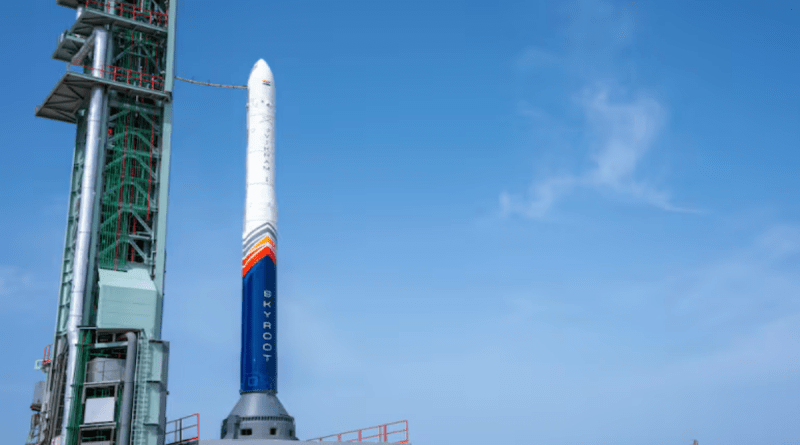
Vikram-1 launched: 10 reasons why Skyroot Aerospace’s Mission Aagaman is a historic first for India
Vikram-1 launched: 10 reasons why Skyroot Aerospace’s Mission Aagaman is a historic first for India
A successful mission would make Skyroot the first Indian private company to place payloads into orbit, opening a new chapter in the country’s commercial space programme.
Skyroot Aerospace launched its Vikram-1 rocket under Mission Aagaman from the Satish Dhawan Space Centre (SDSC), Sriharikota, at 12:05 am on Saturday, marking a landmark moment for India’s private space industry.
The mission is the first orbital launch attempt by an Indian private company using a launch vehicle developed outside the government’s space programme. However, Vikram-1 is more than just another rocket launch. It brings together several technological innovations, engineering breakthroughs and unique payloads that could shape the future of India’s commercial space sector.
Here are 10 key things that make Vikram-1 a historic mission:
1. India’s first private orbital launch attempt
Mission Aagaman is Skyroot Aerospace’s first attempt to place a rocket into orbit. While Indian private companies have contributed to the space sector by supplying components and services, Skyroot is the first startup to independently attempt an orbital mission using its own launch vehicle.
2. India’s first privately developed orbital rocket
🎓 Explore Jobs by Qualification
Explore the latest job opportunities in J&K and across India based on your educational qualification.
Unlike Skyroot’s Vikram-S, which was a suborbital rocket, Vikram-1 has been designed to place satellites into orbit. The mission marks a major shift in India’s space ecosystem, with private companies now developing complete launch systems instead of only supporting government missions.
3. First orbital rocket with an all-carbon composite structure
Vikram-1 is India’s first orbital launch vehicle built entirely using an all-carbon composite structure. The lightweight yet highly durable material is stronger than conventional rocket-grade steel, helping improve efficiency while allowing the rocket to carry more payload.
4. India’s longest monolithic carbon composite rocket stage
The rocket’s first stage is also India’s longest monolithic carbon composite rocket stage. Built as a single integrated structure rather than multiple assembled sections, it showcases advances in indigenous aerospace engineering and composite manufacturing.
5. First fully 3D-printed engine on an Indian orbital rocket
The Orbital Adjustment Module of Vikram-1 is powered by a 100 per cent 3D-printed liquid engine. It is the first fully 3D-printed engine to be used on an Indian orbital launch vehicle and will help position payloads accurately after the main stages complete their task.
6. Advanced low-shock separation technology
The rocket uses an ultra-low-shock pneumatic separation system to detach rocket stages and payload fairings. This technology reduces vibrations and mechanical shock, helping protect delicate satellites during deployment.
7. Space debris removal technology demonstration
Mission Aagaman is carrying the EMBRACE payload, featuring robotic arm technology designed for future space debris removal. The experiment aims to support future efforts to remove inactive satellites and other debris from Earth’s orbit.
8. Lab-grown diamond to travel into space
One of the mission’s most unusual payloads is Cosmic Bloom, a lab-grown diamond that will travel into orbit as an artistic payload. It reflects the growing role of commercial space missions in combining science, innovation and art.
9. Tribute to India’s scientific icons
The rocket is also carrying a miniature 18K gold rocket featuring micro sculptures of Dr Vikram Sarabhai, Sir C.V. Raman and Dr A.P.J. Abdul Kalam. The artwork honours three of India’s greatest scientific pioneers, while the rocket itself is named after Dr Sarabhai, the father of India’s space programme.
10. PM Modi’s handwritten message to fly into space
Adding a symbolic touch to the mission, Vikram-1 will carry a handwritten postcard from Prime Minister Narendra Modi bearing the words “Vande Mataram” along with his signature. The mission will also carry hundreds of handwritten messages from Skyroot’s team, investors and supporters from across the world, making Mission Aagaman not only a technological milestone but also a celebration of India’s growing private space ambitions.