
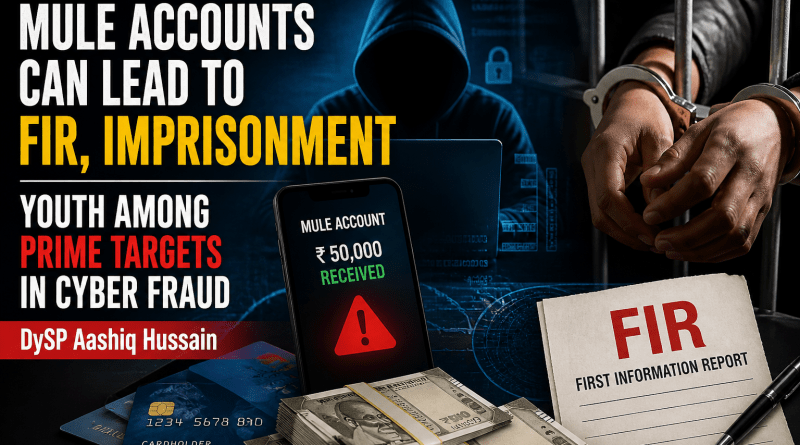
Mule Accounts May Invite FIR and Jail; Youth Prime Targets in Cyber Fraud: DySP Aashiq Hussain
Mule Accounts May Invite FIR and Jail; Youth Prime Targets in Cyber Fraud: DySP Aashiq Hussain
Fraudsters using innocent accounts to route stolen money, public urged not to share bank details
Cyber crime branch experts issued a strong warning over the rising misuse of “mule accounts” in cyber fraud cases, stating that even unaware account holders can face FIRs, legal action, and imprisonment.
Speaking to news agency that, Deputy Superintendent of Police (DySP) Cyber Crime Kashmir, Aashiq Hussain said, “A mule account is essentially a bank account used to transfer or store illegally obtained money. In many cases, the account holder either knowingly allows its use for small monetary benefits or is misled into sharing access under false pretences.”
700+ Posts: SSC Recruitment 2026, Last Date Approaching
He said fraudsters use such accounts to quickly shift stolen money and evade detection. “Once money is fraudulently withdrawn, it is immediately transferred to mule accounts or to traders and businessmen under the guise of legitimate transactions. In many cases, the account holder is unaware of the source of funds,” he added.
Highlighting the consequences, he said such accounts are often debit-freezed after complaints, causing difficulties for genuine holders. “People then have to approach banks and cyber police stations to resolve the issue. Grievances can be filed through banks, which are forwarded to concerned cyber police units for verification,” he said.
He added that depending on the investigation, accounts may either remain frozen or be restored, while affected individuals also have the option to approach higher authorities if their grievances are not addressed.
Pointing to challenges, the officer said many cases involve interstate transactions, making resolution time-consuming and difficult. “People often face delays due to jurisdictional issues and heavy workload at cyber police stations,” he said.
🎓 Explore Jobs by Qualification
Explore the latest job opportunities in J&K and across India based on your educational qualification.
Issuing a specific alert for youth, DySP Aashiq said, “School-going children are increasingly being targeted with offers of easy money. They are asked to route transactions through their accounts in return for small commissions, but legally they become liable for the entire amount.”
JERC Recruitment 2026
“Even if someone keeps just a small share, they can face FIRs, legal action, and imprisonment for facilitating cyber crime. People must not share their bank details or allow unknown transactions under any circumstances,” he said.